Best AWD, 2WD and 4WD Vehicles to Consider This Fall 2026

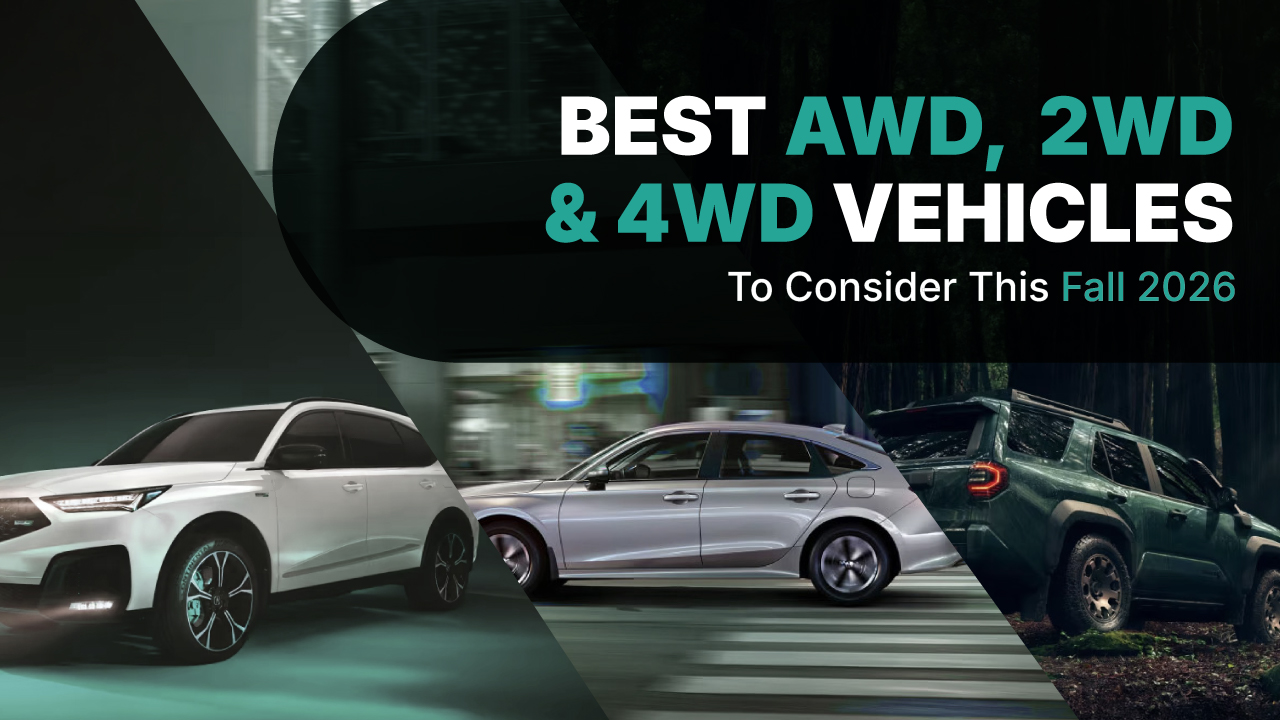
As fall slowly settles across Canada, changing road and weather conditions can quickly turn a routine drive into a more challenging one. Wet leaves, heavy rain, freezing temperatures, early snowfall and icy roads can all affect how your vehicle handles. Many Canadian drivers think a vehicle with all-wheel drive (AWD) is automatically the answer to winter driving and the challenges that come along with it. However, you should also consider other options—two-wheel drive (2WD) and four-wheel drive (4WD)—to determine which drivetrain actually suits your needs.
And if you underestimate the importance of choosing the right drivetrain, consider the variety of driving conditions we experience across Canada. From the city streets of Toronto and Vancouver to snowy roads across the Prairies and winding routes through British Columbia and Alberta, these varied driving landscapes call for different drivetrain setups. Understanding how each system works and which conditions it suits best can help you make a more informed choice.
AWD, 2WD and 4WD each offer different advantages, and the right choice ultimately depends on where and how you drive, as well as your budget. Read on as we take you through each drivetrain, highlight the differences between them and explore top vehicles—including the 2026 Acura MDX, 2026 Toyota RAV4, 2026 Honda Civic, 2027 Toyota Land Cruiser and 2026 Ford F-150—that you can consider this fall as you prepare for winter and the road conditions ahead. With plenty of 2026 and 2027 models offering different drivetrain options, there’s more to consider than simply choosing AWD. Take a look!
Best Manufacturer Vehicle Warranties in Canada
Hybrids vs. PHEVs vs. EVs: Which Saves More Money in Canada’s 2026 Economy?
Canada’s Best Vehicles for Cargo, Payload, and Off-Road Adventure in 2026
What’s the Difference Between AWD, 2WD and 4WD
In simple terms, AWD, 2WD and 4WD refer to how many wheels receive power from the engine and how that power is distributed. While AWD powers all four wheels and generally delivers better grip than 2WD, which powers only two, 4WD is designed to provide additional traction and capability in more demanding driving conditions. Let’s dig a little deeper into all three:
| Features | All-Wheel Drive (AWD) | Two-Wheel Drive (2WD) | Four-Wheel Drive (4WD) |
| Engine Power | All four wheels | Two wheels, either front or rear | All four wheels |
| Traction | Provides added traction, especially on slippery and challenging road conditions | Offers adequate traction, works well on normal road conditions | Provides enhanced traction and is well suited to challenging terrain and off-road conditions |
| Fuel Efficiency | Lower due to additional moving parts | Generally better because of less drag | Lower due to additional drivetrain components |
| Best suited for | Drivers who regularly drive through snow, rain, rough, or slippery roads | Everyday driving on primarily paved, well-maintained roads | Drivers who regularly encounter rough terrain, steep roads, trails or demanding conditions |
| Best models | 2026 Acura MDX, 2026 Mazda CX-5, 2026 Toyota RAV4 | 2026 Honda Civic, 2026 Toyota Camry, 2027 Toyota Corolla | 2027 Toyota Land Cruiser, 2026 Ford F-150, 2026 Toyota 4Runner |
Understanding All-Wheel Drive (AWD)
Built around sensors and differentials, an All-Wheel Drive system powers all four wheels of a vehicle. The system engages automatically and adjusts to road conditions to offer maximum grip and traction on slippery, sloppy roads. But because the system has more moving parts, it offers lower fuel efficiency than vehicles with a 2WD system.
Understanding Two-Wheel Drive (2WD)
Two-Wheel Drive is further split into two distinct types:
Understanding Four-Wheel Drive (4WD)
Like AWD, 4WD also sends power to all four wheels and is designed to provide enhanced traction in challenging road conditions. AWD activates automatically when it detects slip, whereas 4WD must be activated manually, giving the driver more control over how power is distributed. Some models include selectable drive modes to adjust power for different terrains. This makes 4WD particularly well suited for off-road driving, steep or uneven roads, deep snow, mud and other demanding conditions.
AWD or 2WD or 4WD: Which One Do You Need?
Whether you should choose a vehicle with AWD, 2WD, or 4WD depends largely on your driving needs, road conditions, and budget—yes, budget! Compared to AWD and 4WD vehicles, 2WD models are generally more affordable. Many drivers also choose 2WD for better fuel efficiency, and it is often a great pick for everyday driving on well-maintained city roads and highways, such as those commonly found across Southern Ontario and the Prairies. On the other hand, AWD can provide better traction on snow, ice, rain and challenging roads in general, making it a go-to pick for drivers who regularly encounter tough terrain or drive greater distances, no matter the weather. This can be especially useful for drivers navigating heavy snowfall in parts of Ontario and Quebec, or winding roads in British Columbia and Alberta. If you regularly drive on rough terrain, steep roads, trails or through deep snow and mud, 4WD may be the better fit. Its added traction and selectable drive modes make it particularly useful for off-road adventures.


Best Vehicles in Canada for Fall 2026
From practical SUVs to capable trucks and luxury vehicles, here are some of the top vehicles, with either AWD, 2WD or 4WD systems to consider in Canada for fall 2026:
Best AWD Models for 2026
1. 2026 Acura MDX
Paired with the Super Handling All-Wheel Drive (SH-AWD) system and torque vectoring technology, the 2026 Acura MDX delivers confident performance and agility across changing road conditions. This AWD system distributes torque across all four wheels, while torque vectoring technology helps direct power between the rear wheels to improve stability and traction, giving Canadian drivers added confidence and control when conditions get challenging.
2. 2026 Mazda CX-5
As road and weather conditions change in fall, the 2026 Mazda CX-5 makes perfect sense for Canadian drivers who want to prepare for winter. The Mazda CX-5 comes with a standard i-Activ AWD System that performs about 200 calculations per second to determine how much torque to distribute between the front and rear wheels. It also monitors factors such as front-wheel torque consumption, wiper operation and exterior temperature to adjust performance accordingly, helping you enjoy a smooth, well-balanced ride.
3. 2026 Toyota RAV4
Standard on all 2026 Toyota RAV4 models, the all-wheel drive system offers superior traction to help support you on your road adventures, especially when the roads get tough. Beyond added traction, this standard AWD system on the RAV4 also improves handling and stability when cornering and accelerating. Moreover, in the compact SUV segment, the Toyota RAV4 is a great choice for tackling challenging autumn and winter roads while delivering good efficiency at a budget-friendly price.
Best 2WD Models for 2026
1. 2026 Honda Civic
The 2026 Honda Civic is a front-wheel-drive (FWD) sedan that offers a practical, fuel-efficient option for everyday driving. For Canadian drivers, the Civic can handle typical fall conditions like rain and wet roads, while the right winter tires can add traction when temperatures drop and snow arrives. It’s a sensible choice for drivers who primarily travel on well-maintained roads in big cities like Calgary, Toronto or Vancouver.
2. 2026 Toyota Camry
All the 2026 Toyota Camry models come standard with front-wheel drive, offering a combined horsepower of 225 for smooth, efficient driving. With the right winter tires, the Camry can also handle the colder, wetter conditions Canadian drivers experience in fall and winter. In addition to the standard FWD system, the 2026 Camry is also available with Electronic On-Demand All-Wheel Drive (eAWD) to handle tougher roads, boosting the total horsepower to 232.
3. 2027 Toyota Corolla
Like the Honda Civic, the 2027 Toyota Corolla also features an FWD system that helps with efficient performance and smooth handling. For drivers who primarily commute in urban areas and don’t regularly come across deep snow or rough terrain, the Corolla’s FWD setup can offer a good balance of everyday drivability and efficiency.
Best 4WD Models for 2026
1. 2027 Toyota Land Cruiser
The 2027 Toyota Land Cruiser comes equipped with a full-time 4WD system that continuously distributes power to the front and rear axles for confident performance across challenging terrain. With the push of a button, drivers can lock the centre differential for additional traction and control when tackling off-road trails, uneven surfaces or demanding driving conditions.
2. 2026 Ford F-150
Whether you’re navigating snowy rural roads in the Prairies, gravel trails in Ontario, or rugged terrain in British Columbia and Alberta, the 2026 Ford F-150 has your back no matter the terrain, thanks to its capable 4WD system. This drivetrain offers up to 8 drive modes, including Normal, Slippery, Deep Snow/Mud, and Off-road, so you can adjust performance as needed.
3. 2026 Toyota 4Runner
The 2026 Toyota 4Runner gives drivers the flexibility to choose the drivetrain that best suits their needs, with available part-time 4WD and full-time 4WD systems depending on the configuration. In autumn, when roads are generally easier to navigate, the 4Runner’s part-time 4WD can add capability when needed. At the same time, its available full-time 4WD system is designed to provide enhanced traction and control in more challenging conditions. This makes the 4Runner well suited to a variety of terrain, including mud, snow and uneven or slippery roads.
Upgrade Your Ride with Cars.ca
Want to bring home any of the models above? Find them all at Cars.ca, a go-to auto marketplace that brings thousands of new and used vehicles from all over Canada right to your favourite smart devices. Whether you’re dreaming of a family minivan, a road-ready SUV, or a workaholic pickup truck, our ad-free platform lets you browse, compare, daydream, and get one step closer to hitting the road. Whatever you’re looking for, find it on Cars.ca, helping you get behind the wheel of your next set of wheels faster and more conveniently.


